
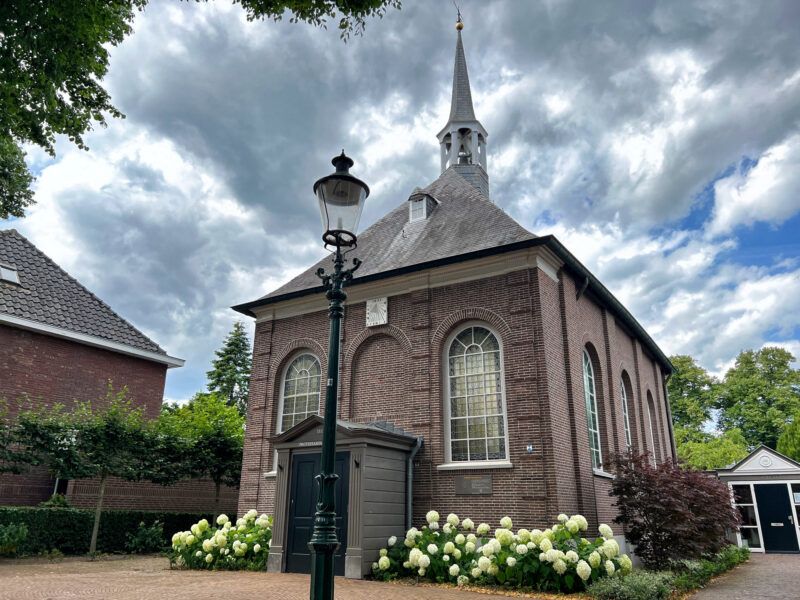
Lodewijkskerkje
This national monument dates back to 1810. The Protestants received 7,000 guilders from Louis Napoleon to build the little church, after the Petrus Church had to be returned to the Roman Catholics.
More on the history of St. Peter's Church
The Lodewijkskerkje was dedicated on Sept. 2, 1810. Before that time, since 1648, Protestants had been attending church in the nearby Petrus Church. This was actually a Catholic church. But in the Netherlands, the Nederduitsch Gereformeerde Kerk was designated a state church. No other churches or denominations were allowed. Catholics in those years had to rely on a barn church.
Liberty, equality and fraternity
At the end of the 16th century, the French entered our country. They brought with them the principles of the French Revolution. For example, Catholics were allowed to practice their religion openly again. St. Peter's Church had to be returned to the Catholics. But where were the Protestants to have their churches?
Lode...
This national monument dates back to 1810. The Protestants received 7,000 guilders from Louis Napoleon to build the little church, after the Petrus Church had to be returned to the Roman Catholics.
More on the history of St. Peter's Church
The Lodewijkskerkje was dedicated on Sept. 2, 1810. Before that time, since 1648, Protestants had been attending church in the nearby Petrus Church. This was actually a Catholic church. But in the Netherlands, the Nederduitsch Gereformeerde Kerk was designated a state church. No other churches or denominations were allowed. Catholics in those years had to rely on a barn church.
Liberty, equality and fraternity
At the end of the 16th century, the French entered our country. They brought with them the principles of the French Revolution. For example, Catholics were allowed to practice their religion openly again. St. Peter's Church had to be returned to the Catholics. But where were the Protestants to have their churches?
Louis Napoleon arranged it himself
The church congregation first resisted the return of the Petruskerk to the Catholics. But when King Lodewijk Napoleon himself came to Oisterwijk in 1809 and summoned Pastor Cornelis van Strijen and Pastor Johannes van der Bruggen, it was quickly settled. The pastor got the church and the pastor 7,000 guilders to build a new church.
A new church in six months
Architect van Heijst from Waalwijk drew a simple hall church. Two carpenters, Augustinus de Bresser and Willem van der Loo, built a new church in six months. On Sept. 2, 1810, was the grand opening. A few years later, the organ was purchased to accompany the chants in the worship services.
Reformed and Reformed
The Dutch Reformed Church merged into the Reformed Church. The Reformed chose their own way. In 1930 a Reformed church was built in the Kievitslaan. At the end of the last century Reformed and Reformed people reunited. Together with individual members of other Protestant denominations, they formed the Protestant Congregation Oisterwijk, part of the Protestant Church in the Netherlands (PKN).
National Monument
During the war, the church was badly damaged but restored. In 1973, the church was thoroughly restored. In 2013, the church was adapted to the requirements of the 21st century. But always preserving the elementary monumental values. The church is a national monument.